
Oumi Now Runs Inside Your Own Cloud
Built with Tensor9. Your data never leaves your VPC.
By Erik Bower and Min Song
September 15, 2026
Oumi and Tensor9 shipped Bring Your Own Cloud (BYOC). Run the full Oumi Platform in your own environment, whether on AWS, Azure, Google Cloud, or on-premises.
The Oumi Platform builds, deploys, and monitors your AI models: evals, data synthesis, and the feedback loop that turns production signal into a better model. BYOC changes where that work runs, not what it does. Your leadership sets the data residency requirements. Your security team controls who can access the platform and how. Your engineers use the infrastructure, logging, and change controls they already rely on.
Why data residency, why now
Enterprise customers keep asking for this. Banks run loan decisions off borrower financials and credit history. Insurers run claims triage against medical and financial records. Health systems store protected health information for clinical documentation and coding.
For that work, a vendor's privacy policy isn't enough. Security teams need to know exactly where the data sits, who can reach it, and which system controls it.
BYOC answers that directly. Deploy Oumi inside your VPC and your data never leaves it. It's stored, processed, and maintained entirely inside your own environment, under your own controls.
When evaluation, training, and serving run across separate tools, each one adds another place to track your data. Oumi brings that work together. With BYOC, it runs inside your own environment.
"The real test for enterprise AI isn't whether it works in a demo but whether a company can run it within the controls the company already trusts. We're excited to work with Oumi on a BYOC deployment path that brings Oumi into the customer's own cloud account."
— Michael Ten-Pow, CEO and co-founder, Tensor9
Built with Tensor9
Building BYOC infrastructure usually means choosing between a rigid one-off install or heavy operational overhead. Working with Tensor9, Oumi built a repeatable, production-grade deployment model that skips both.
Tensor9 provides the deployment and orchestration layer for Oumi, including onboarding, versioned releases, and ongoing updates. A controller inside each customer environment connects to Oumi's control plane to manage the deployment. The Oumi Platform runs inside the customer's own VPC.
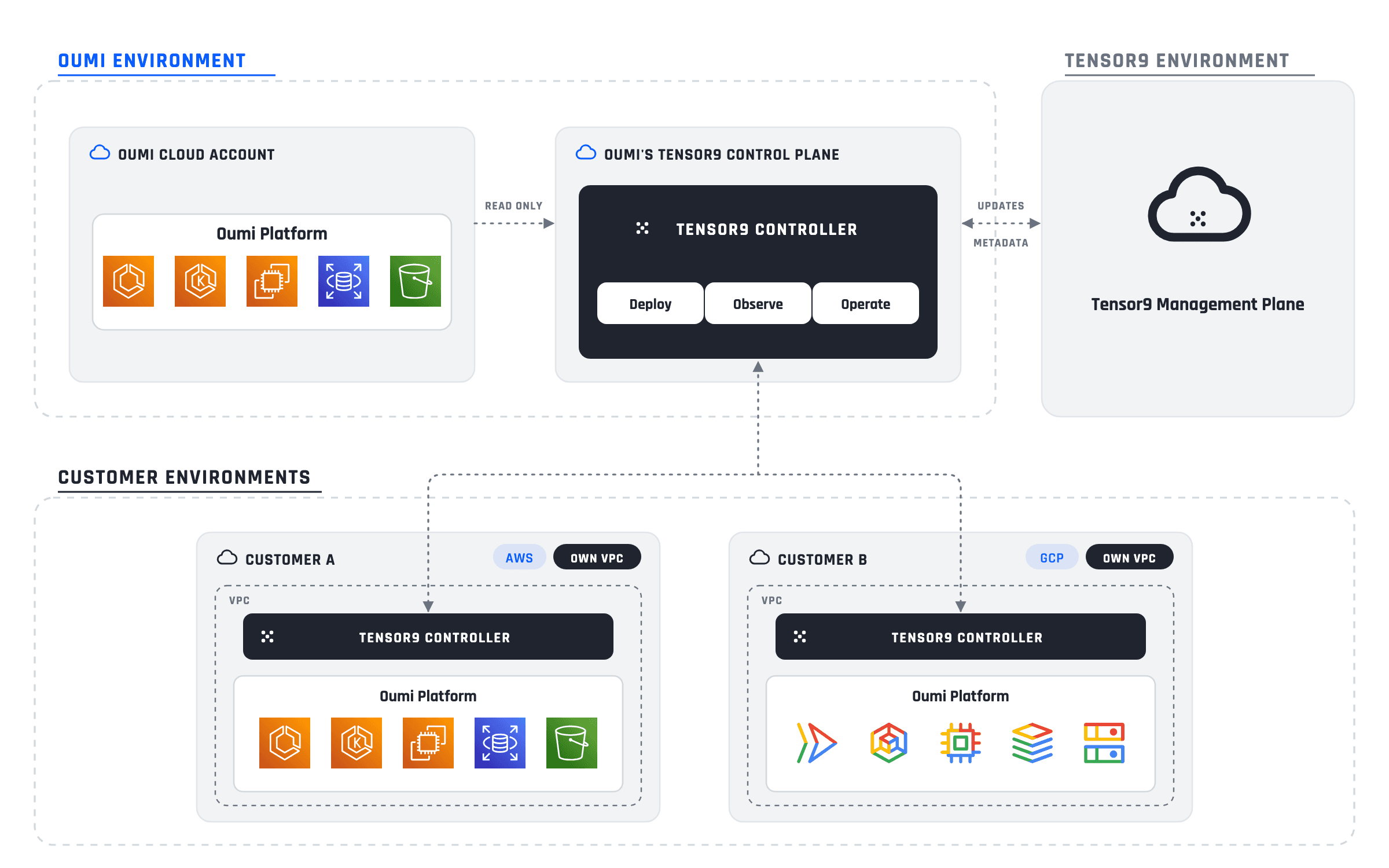
With Oumi BYOC, you keep full control over where your AI workloads run. Run training and inference on VMs in your VPC or on your own Kubernetes or Slurm clusters. Your team decides which external services the platform can use. We tailor each deployment to your cloud provider, region, network, and security requirements. That includes configuring AI features such as the Oumi agent and LLM-as-a-judge evaluations to use models running inside your VPC, so prompts and responses stay within your environment.
Oumi also handles updates and releases through Tensor9, bringing new platform features into your environment. You get the convenience of a managed service without maintaining a separate version of Oumi or handing over broad access to your data.
Hosted SaaS vs. BYOC
Hosted SaaS is still the fastest way to start, and it's the right call for most teams.
BYOC is the better call once you need more control over data, workflow, or approvals than a shared hosted environment gives. That happens once the AI system has to sit in the same cloud account as the data and services it touches. Maybe you need a specific cloud region. Maybe your team has to approve every change before it ships. Both get common once AI moves into a core business process.
Same platform, your cloud
BYOC doesn't change what the Oumi Platform does. It changes where it runs, and who controls it.
You still use Oumi to evaluate, train, and improve models on production feedback. With BYOC, you do it inside the cloud account you already govern.
Less debate about where the platform lives. More time deciding when your model is ready to ship.
