
Train & improve
Train your best specialized models and agents. Then continuously improve them.
Oumi brings the full model and agent improvement loop into one platform, with FAiE automating the AI engineering work under your control.
Start with any model or agent, find where it fails, improve it with targeted data and training, then use production feedback to keep getting better.
FAiE
Meet FAiE, your Frontier AI Engineer Agent
FAiE works for you to build your models and agents.
From goal to execution plan
Tell FAiE what you want to build. It creates a step-by-step plan across models, data, evaluations, training methods, and tools.
Build with confidence
FAiE analyzes results, identifies the highest-impact improvements, and validates each iteration against your baseline.
Automate the hard parts
Automate complex AI engineering workflows that typically require specialized expertise and significant manual effort, while retaining full visibility and control.
AGENTS
Build, evaluate, and train agents end to end.
Create agentic training data, define tools and tool behaviors, simulate or connect real tool executions, and evaluate complete multi-turn trajectories across user interactions, tool calls, and final outcomes.
Agentic data synthesis
Generate conversations with users, tool calls, and tool responses for training and evaluation.
Tools
Define the functions, parameters, and schemas available to the agent. Use simulated tools for reproducible testing or connect real endpoints for realistic execution.
Agent evaluations
Evaluate the full trajectory: from tool selection and arguments to user interactions and task completion.
Bring Your Own Harness
Improve agents without rebuilding them in Oumi.
Connect your existing agent harness while keeping your orchestration, tools, state, and execution environment in your own stack. Use Oumi to generate agentic data, evaluate agent performance, and train the models that power your agent. Read more about agent harnesses
- Your harness
- Your runtime
- Oumi data synthesis, evaluation, and training
TRAINING
Fine-tune and optimize open models for your task using frontier post-training.
SFT
Supervised fine-tuning on your own or Oumi-generated datasets.
FFT
Update all model parameters rather than training adapter weights.
LoRA
Parameter-efficient fine-tuning for faster iteration and lower compute requirements.
OPD
Train a smaller model using outputs generated from its own policy and a stronger teacher model.
DPO
Optimize against preferred and rejected responses using Direct Preference Optimization.
- Contact us: GRPO
GRPO
Reinforcement learning for optimizing model behavior against task-specific rewards. Private preview.
DATA SYNTHESIS
Generate the training and evaluation data you need.
Create complete synthetic datasets from scratch, generate responses for existing input datasets, or transform your PDFs and documentation into task-specific data.
Dataset generation
Generate complete datasets from a task description, schema, or examples.
Completion generation
Take an existing dataset of prompts or inputs and generate model completions at scale.
Agentic data
Generate conversations that include user turns, assistant responses, tool calls, and tool results.
Documents → datasets
Generate structured training or evaluation data grounded in PDFs, documentation, and other source material.
Production traces
Import LangSmith or LangFuse production traces as conversation datasets for evaluation, synthesis, and training.
EVALUATION
Evaluate models and agents against the requirements of your application.
Run repeatable evaluations across model candidates, trained checkpoints, and agents using LLM judges or deterministic evaluators.
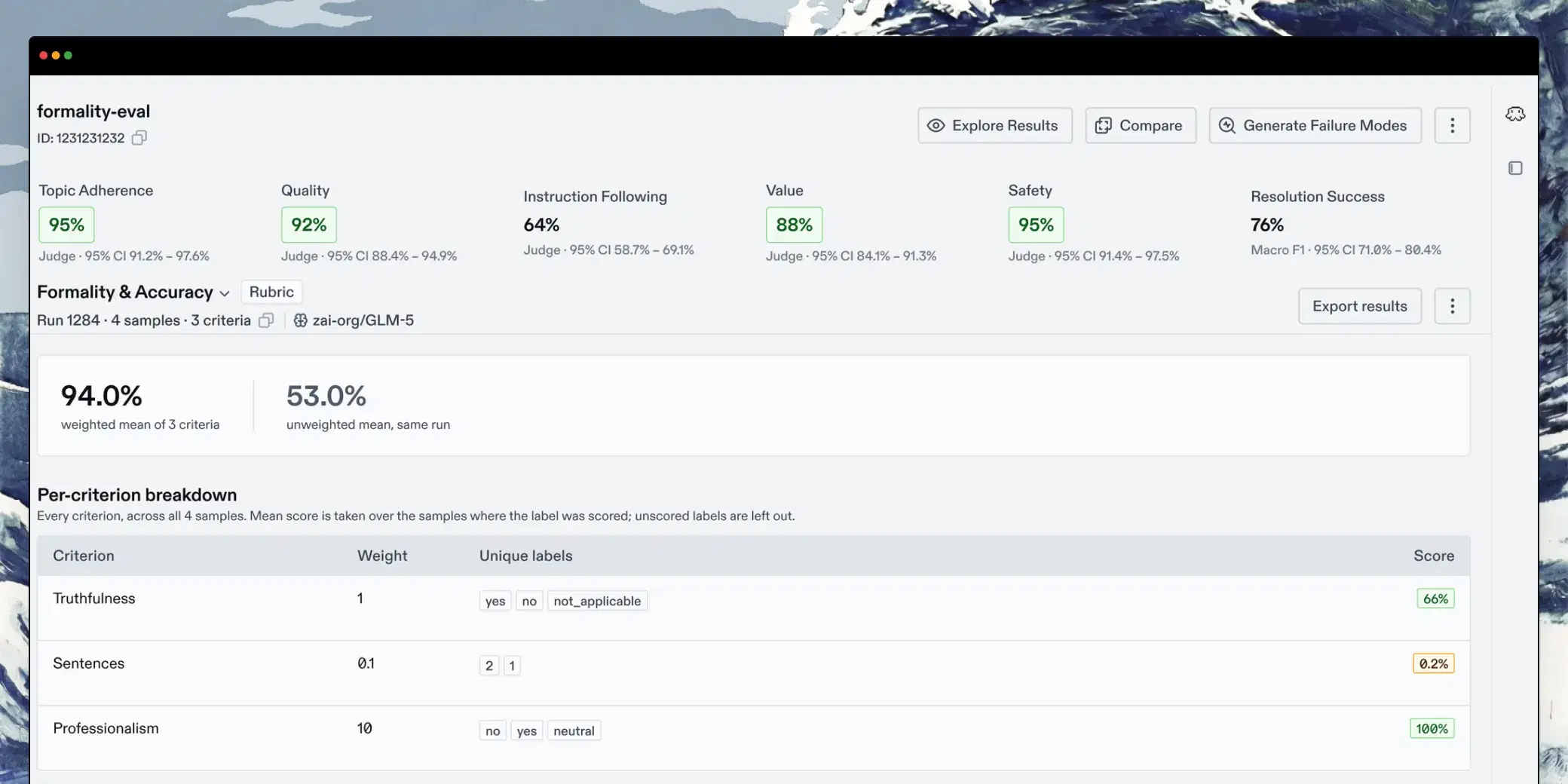
LLM-as-a-judge
Evaluate open-ended properties such as correctness, instruction following, tone, safety, and task completion with configurable judge models, criteria, labels, and scores.
Rubric evaluators
Evaluate multiple criteria in a single judge call. Define independent criteria, weights, labels, and scores, and inspect which individual requirements passed or failed.
Classification evaluators
Compare predicted labels against ground-truth labels for classification tasks without using an LLM judge.
Extraction evaluators
Evaluate NER, structured-output / JSON-schema, and function-calling tasks. Verify whether each extracted value is grounded in the source text, even when labeled ground truth isn’t available.
FAILURE ANALYSIS
Automatically find the patterns behind evaluation failures.
Oumi analyzes evaluation results and groups recurring errors into failure modes, helping you distinguish systematic weaknesses from individual bad outputs.
Identify issues such as reasoning gaps, instruction-following failures, formatting problems, tool-use errors, and unsafe behavior. Select the failure modes you want to address and generate a targeted dataset directly from them.
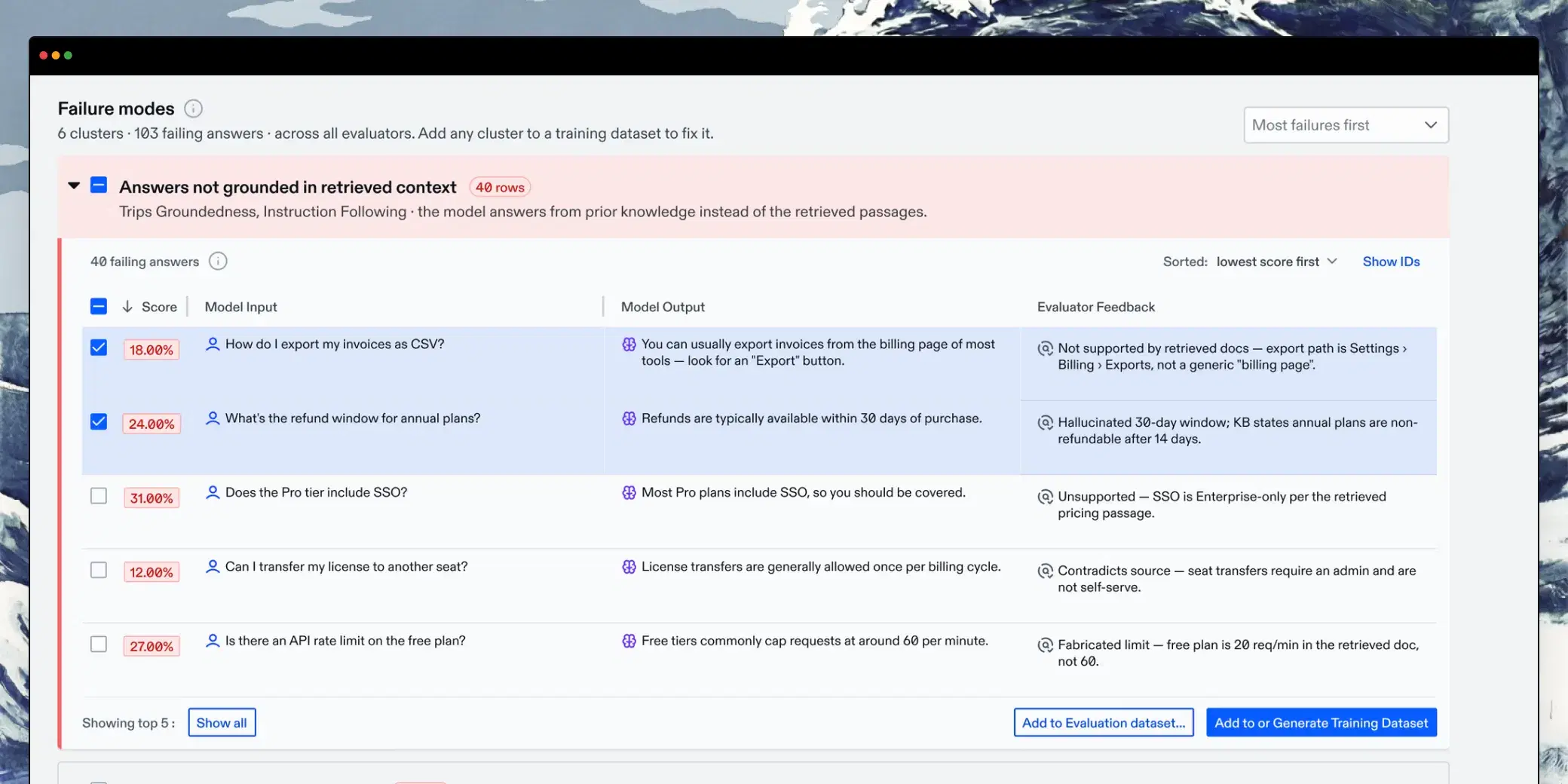
- Automatic failure-mode discovery
- Error clustering
- Row-level inspection
- Targeted dataset generation
Model playground
Test and compare any models side-by-side.
Run the same prompts across frontier, open, and fine-tuned models. Compare responses side by side, adjust inference settings, and move promising candidates into structured evaluation.
- Frontier models
- Open models
- Fine-tuned models
- Side-by-side comparison
- Configurable inference
Reproducible recipes
Define recipes once. Reuse them across runs and teams.
Oumi recipes are reusable JSON configurations for data synthesis, evaluation, and training jobs. Save, share, rerun, or modify a known configuration without rebuilding it from scratch. Each recipe also preserves lineage, so you can always trace how any dataset or model was produced.
- Data synthesis
- Evaluation
- Training
- Reusable JSON
- Reproducible experiments
Build AI your business owns.
Start with the task. Oumi connects the work, your team controls the decisions, and the intelligence runs where your business needs it.